


Authors: Serafim & Alex, transgender people
Representing trans and non-binary people across various forms of media, including film, television, literature, and music, is crucial to increasing their visibility, both within the LGBTQ+ community and the general public. Correctly depicting our experiences and struggles allows for a clear and constructive portrayal, without leaning into stereotypes and prejudices, which is essential in the battle against misinformation.
What makes for a good representation?
In media, representation can be done in a variety of ways, either directly through characters, or indirectly through metaphors.
Good representation is based on real people’s experiences, thorough research on the topic, and the use of language that conveys empathy and regard. Anyone can represent the transgender community in their media with the right knowledge and a respectful approach.
Examples of shows featuring good transgender representation
Pose (TV series)

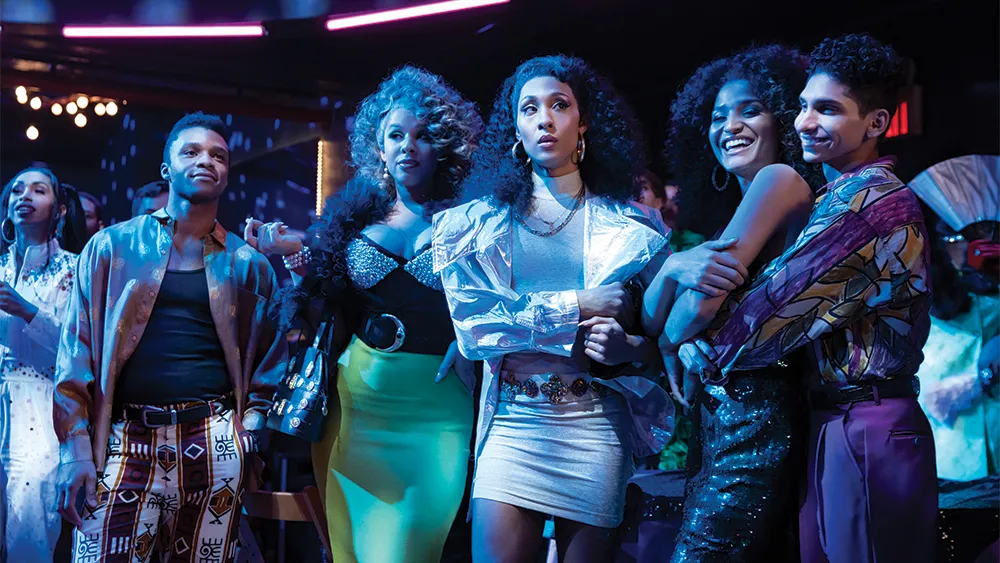
Set in the 80-90’s New York during the AIDS crisis, Pose focuses on ballroom culture and the gay/transgender community.
The series was created to reflect the specific struggles of the community during that time period, depicting its journey in overcoming those hardships and fighting for recognition and rights while combating stigma and misinformation. All the transgender characters (which there are plenty of) are played by real-life trans women of color, bringing exposure to them, their talents, and careers.
Pose shows the realities of being a transgender woman during the 80’s and 90’s, which includes dealing with everyday transphobia, resorting to unsafe methods of gender-affirming treatment, being targeted by the cishet society, and being forced to do sex work in order to survive.
Nimona (Animated movie)

Nimona is an animated tale that follows a knight (Ballister) accused of a crime he didn’t commit, along with his shapeshifter sidekick (Nimona), who may be the “monster” he swore to kill.
While it wasn’t explicitly stated that the movie is an allegory for trans/non-binary people’s struggles, many people within the spectrum have found themselves represented through Nimona’s experience of never fitting in, regardless of the form she took. Furthermore, the story effectively demonstrates how supposed allies can, in fact, turn out to be judgemental and accusing. This is evident when Ballister, who is queer himself, tells Nimona to “just be a girl”, only coming to fully accept her true identity at the end of the movie. Unfortunately, similar situations may occur in real-life queer spaces, with non-cisgender people struggling to fit in despite being part of the same community.
The movie advocates for the idea that we must look beyond appearances in order to see the person for who they really are. Even if we struggle to understand their identity, we have to remain respectful and open-minded.
The Umbrella Academy (TV series)

While the series has a couple of LGBTQ+ characters, the most notable one is Number Seven/Viktor Hargreeves, known in previous seasons as Vanya Hargreeves. Viktor’s actor, Elliot Page, came out as a transgender man during the filming of the third season.
The show’s writers handled the topic of transition with proper respect and understanding, changing his character from a woman to a man, and had him come out to the other characters within the show itself.
What makes for a bad representation?
Generally speaking, bad representation of transgender people stems from poor research on the topic, and is frequently based on stereotypes, such as hormonal transition causing severe health issues, transgender people being mentally ill solely due to their gender identity, transition regrets, and many others.
It is not uncommon for writers to villainize transgender characters, particularly transgender women.
Examples of shows with bad transgender representation
The Silence of the Lambs (Novel, Movie)
While both the novel and the movie are regarded as classics and have received major praise from their audiences, most people overlook the fact that the main antagonist is a serial killer who targets women in order to harvest various body parts with the goal of “building” himself a “woman suit”. He thinks of his victims as mere objects rather than human individuals, whom he consistently refers to as “it”.
Jame Gumb, the villain in question, is depicted as a psychiatric case: unstable, confused about his gender, and experiencing profound hatred for his body. The story accentuates how his traumatic childhood has ultimately defined his identity. In the movie, Jame also displays stereotypical feminine traits, such as manner of speech and body language. He wishes to become a woman, but repeatedly fails to qualify for gender reassignment surgery.
This depiction villainizes and demonizes transgender women, reinforcing the stereotype that they are mentally ill, hate their bodies, and will ultimately target cisgender women.
CSI: Crime Scene Investigation (TV series)
There are sequences where the main characters openly ridicule transgender victims of murder during the examination of their bodies and crime scenes, as well as the trans-identified serial killer who murdered his own mother.
Nip/Tuck (TV series)
The series features a transgender woman who regrets her transition, a transgender sex worker getting beaten, and a full season dedicated to a psychopathic transgender woman, who is depicted as a baby-stealing sexual predator who sleeps with her own son.
Some not-so-fun stats
Since 2002, GLAAD has catalogued 102 episodes and non-recurring storylines of scripted television that contained transgender characters, 54% of which were categorized as containing negative representations at the time of their airing.
Additionally, GLAAD has detected the following:
- Transgender characters were cast in a “victim” role at least 40% of the time;
- Transgender characters were cast as villains or killers in at least 21% of the catalogued episodes and storylines;
- A fifth (20%) of all transgender characters were portrayed as sex workers, making it the most common occupation;
- Transphobic slurs, language, and dialogue were present in at least 61% of the catalogued episodes and storylines.
Source: glaad.org
In conclusion, media representation of transgender people has come a long way, and throughout the years there has been a gradual increase in the amount of better-written and thoughtfully researched transgender characters.
In order to be able to represent this community in an appropriate and respectful way, not only is it important to do thorough research, but also study the good and bad examples of depiction in the existing media. These examples can serve as a stepping stone to understanding what was done right and what can be improved.
