


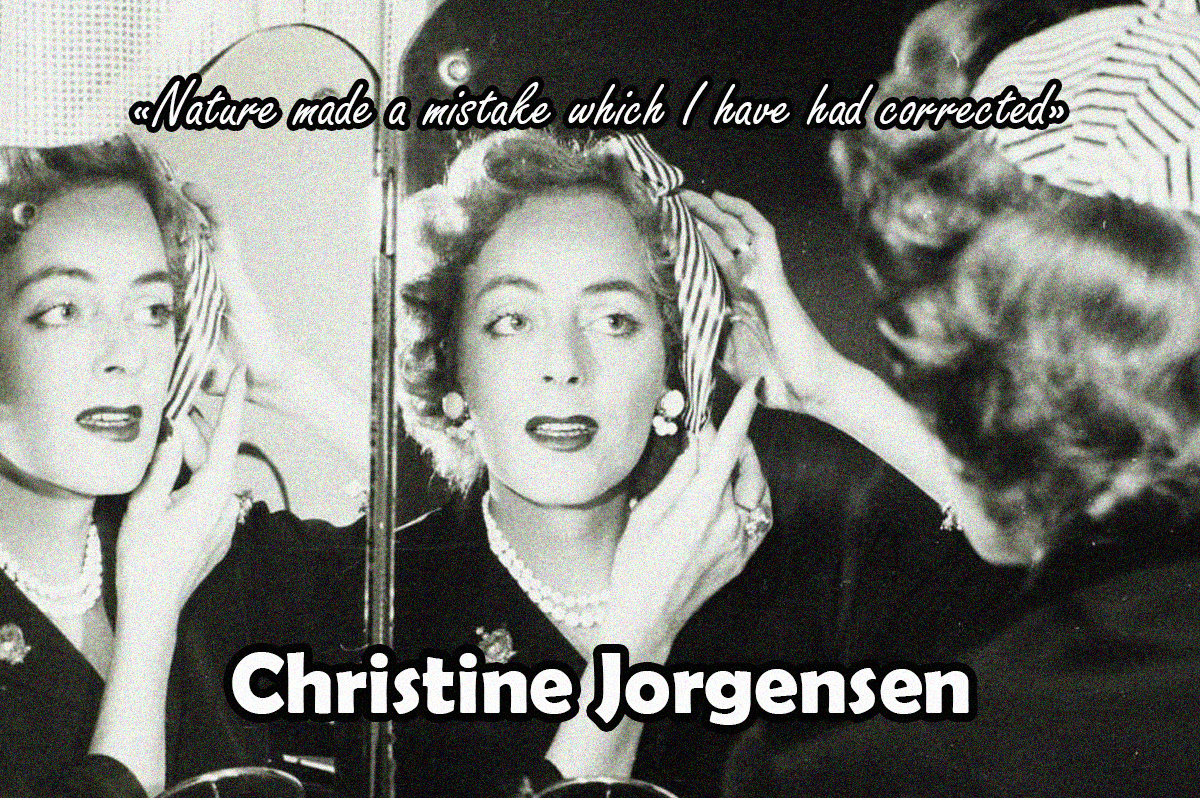
Although the term “transgender” emerged in the 1960s, humans have long resisted the gender binary. One of my previous articles briefly mentioned Christine Jorgensen – a transgender woman from the United States who became widely known for undergoing gender-affirming surgery (then referred to as “sex reassignment surgery”). This article will go more in-depth into her personal and public journey, as well as discuss the impact of her legacy.
Personal journey
Born in 1926 in New York, Jorgensen felt like a woman trapped inside a man’s body from an early age. She felt repulsed by boys’ clothes and wondered why hers were so different from her older sister Dorothy’s beautiful dresses, as she wrote in American Weekly in 1953. As a teenager, she said that she felt “lost between the sexes”, and rather than being attracted to girls, she felt envious of them.
At the age of 19, Jorgensen was drafted into the U.S. army, where she ended up working as a clerk. Upon returning home after being honourably discharged in 1946, she began considering medical transition. At first she took estrogen in the form of ethinylestradiol. She also began researching gender-affirming surgery with the help of Joseph Angelo, the husband of a classmate at the Manhattan Medical and Dental Assistant School. As gender-affirming care was only available in Europe at the time, Jorgensen initially set out for Sweden. However, during her stay in Copenhagen, she was put in contact with Christian Hamburger – a Danish endocrinologist and specialist in rehabilitative hormonal therapy associated with the Serum Institute. He guided her through hormone replacement therapy (HRT), and she chose the name Christine in his honour.
With special permission from the Danish Minister of Justice, Jorgensen underwent a series of gender-affirming surgeries in Denmark: orchiectomy (the removal of testicles) in 1951 and penectomy (penis removal through surgery) in 1952. She eventually returned to the U.S. to receive vaginoplasty (the construction of the vagina) in 1954, as the procedure became available, which was performed under the direction of Dr. Angelo, with Harry Benjamin as a medical adviser.
In her post-surgery letters to her friends, she wrote: “As you can see by the enclosed photos, taken just before the operation, I have changed a great deal. But it is the other changes that are so much more important. Remember the shy, miserable person who left America? Well, that person is no more and, as you can see, I’m in marvelous spirits.”
Publicity
Jorgensen never intended to disclose her transition journey to the public. However, she was forcefully outed when her letter to her parents leaked to the New York press. The letter, outed by the New York Daily News newspaper, stated, “Nature made a mistake which I have had corrected, and now I am your daughter.”
“There was only a short time on that December morning for dreaming about my personal miracle, which I then hoped always to keep from the world at large. As the clock struck 10, a strange young woman came into my room, quite unceremoniously took my hand and said, ‘I have a telegram for you from New York.’ […] The press telegram told me that my carefully guarded secret had been blazoned across the front pages of the American newspapers: ‘BRONX EX-GI BECOMES A WOMAN’… ‘DEAR MUM AND DAD, SON WROTE, I’VE NOW BECOME YOUR DAUGHTER.’ Those were the headlines which I later had to face without shuddering. Gone was my naive dream that I might return to the United States and fit into the pattern of normal living.” – Christine Jorgersen in The American Weekly, “The Story of my Life”, 1953
Jorgensen became an instant celebrity as she arrived in New York in February 1953, met by hundreds of journalists who largely ignored the Danish Royal Family that was on the same flight. She quickly became overwhelmed by the attention, as she said, “I thank you all coming, but I think it’s too much.” However, she eventually embraced her fame and used it to her advantage. She launched a successful nightclub act, later saying, “I decided if they wanted to see me, they would have to pay for it,” as well as appeared across various media platforms available at the time, such as radio, television, and theatrical productions. In her act, she often sang “I enjoy being a girl”.
During the 1970s and the 1980s, Jorgensen offered lectures about her experiences at university campuses and other venues. She also worked as an actress, performing in New York, the Hollywood Area, Manhattan, and Copenhagen.
Unfortunately, Jorgensen faced hurdles with some of her legal documents, such as updating the gender marker on her original U.S. birth certificate. Due to being listed as “male”, she was denied the marriage license in 1959 while attempting to marry her fiancé Howard Knox. The New York Times later reported that Knox had lost his job in Washington, D.C. when his engagement to Jorgensen became known.
Legacy
Jorgensen’s publicity following her transition became “a model for other transsexuals for decades. She was a tireless lecturer on the subject of transsexuality, pleading for understanding from a public that all too often wanted to see transsexuals as freaks or perverts… Ms Jorgensen’s poise, charm, and wit won the hearts of millions.”
Jorgensen helped raise awareness about gender identity as a more inclusive subject, as well as influenced other transgender individuals to seek gender-affirming care and change their legal documents.
In one of her last reviews, she stated that, although the general public knew more about transgender people than they did when she received gender affirming surgery, there were still some things that people outside of the transgender community didn’t seem to comprehend. She said, “What people still don’t understand is that the important thing is identity. You don’t [transition] primarily for sexual reasons, you do it because of who you are.”
In the modern day, Jorgensen is one of the inaugural 50 American “pioneers, trailblazers, and heroes” included on the National LGBTQ Wall of Honor within the Stonewall National Monument (SNM) in New York City’s Stonewall Inn, which is the first U.S. national monument dedicated to LGBTQ+ rights and history.
