


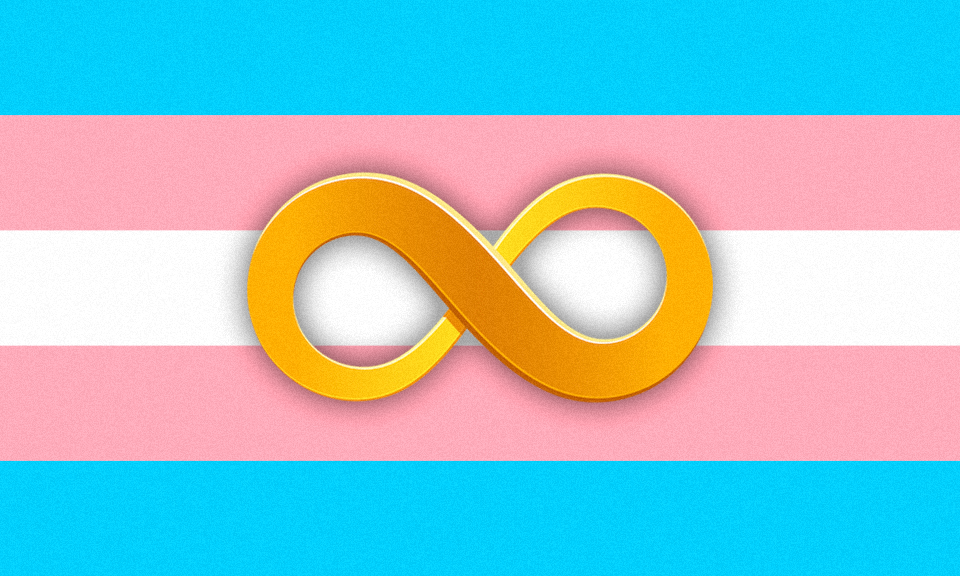
According to a new study by scientists at the University of Cambridge’s Autism Research Centre, autistic people are three to six times more likely to identify as transgender or non-binary. Although being autistic doesn’t make someone trans, and being trans doesn’t make someone autistic, there is a strong overlap between autism and gender diversity. The underlying reasons for this are yet to be fully understood, though they are thought to involve a blend of biological, psychological, and societal factors.
The key factor, supported by both the researchers and many gender-diverse people, is centered around the idea of gender being a social construct. Society has a strict definition of what being a man/woman is, which comes with a wide range of pre-defined standards, expectations, roles, and values. In the meantime, many autistic people struggle with adhering to conventional social norms and deciphering the unspoken social rules, which prevents them from automatically assigning themselves with what society tells them to assign with.
“I’d always find it weird whenever I was expected to look/act/identify a certain way just because I have a specific combination of chromosomes. Most people don’t question these things as they grow up, they just see them as the universal ‘norm’. And whenever this ‘norm’ was pushed onto me, whether by family or peers, I’d always ask them why. They’d never tell me why, their only answer being ‘Well, that’s just the way it is’. I should also note that gender socialisation plays a significant role here. People learn and internalise the behaviours, expectations, values, and cultural norms typically associated with their birth sex. Autistic people find it harder to pick up on social cues (it ends up being a learned skill), therefore they are less likely to assign themselves with those tied to gender identity and gender expression. This is one of the reasons why an autistic person is more likely to explore their gender, or express themselves in a more gender-nonconforming way even if they are cis.” – Luci, genderqueer
A different approach to processing social norms often causes some autistic individuals to view gender in ways that are more abstract. This disconnect from traditional gender categories may lead them to use concepts other than human (for example, nature or animals) to describe their personal experiences with gender. This is known as identifying as xenogender.
Some biological factors have also been proposed to explain the overlap between autism and gender diversity, such as prenatal hormone exposure, which has been linked with sexual orientation, gender dysphoria, and autism. However, the evidence for this is an evolving theory rather than a proven cause.
Ultimately, the overlap between autism and gender diversity can’t be reduced to a single explanation. Autism may affect how someone relates to gender expectations, while biological factors may also play a role. However, given how people’s experiences vary enormously, it is impossible to define gender diversity or autism through a single, universal lens.
This shows that gender isn’t as simple or limited as society often claims. Given that autistic people often process social rules differently, it can be easier for them to question the rigid categories established by society, or they might experience gender in ways that do not align with conventional labels. That doesn’t make either experience more or less valid.
